
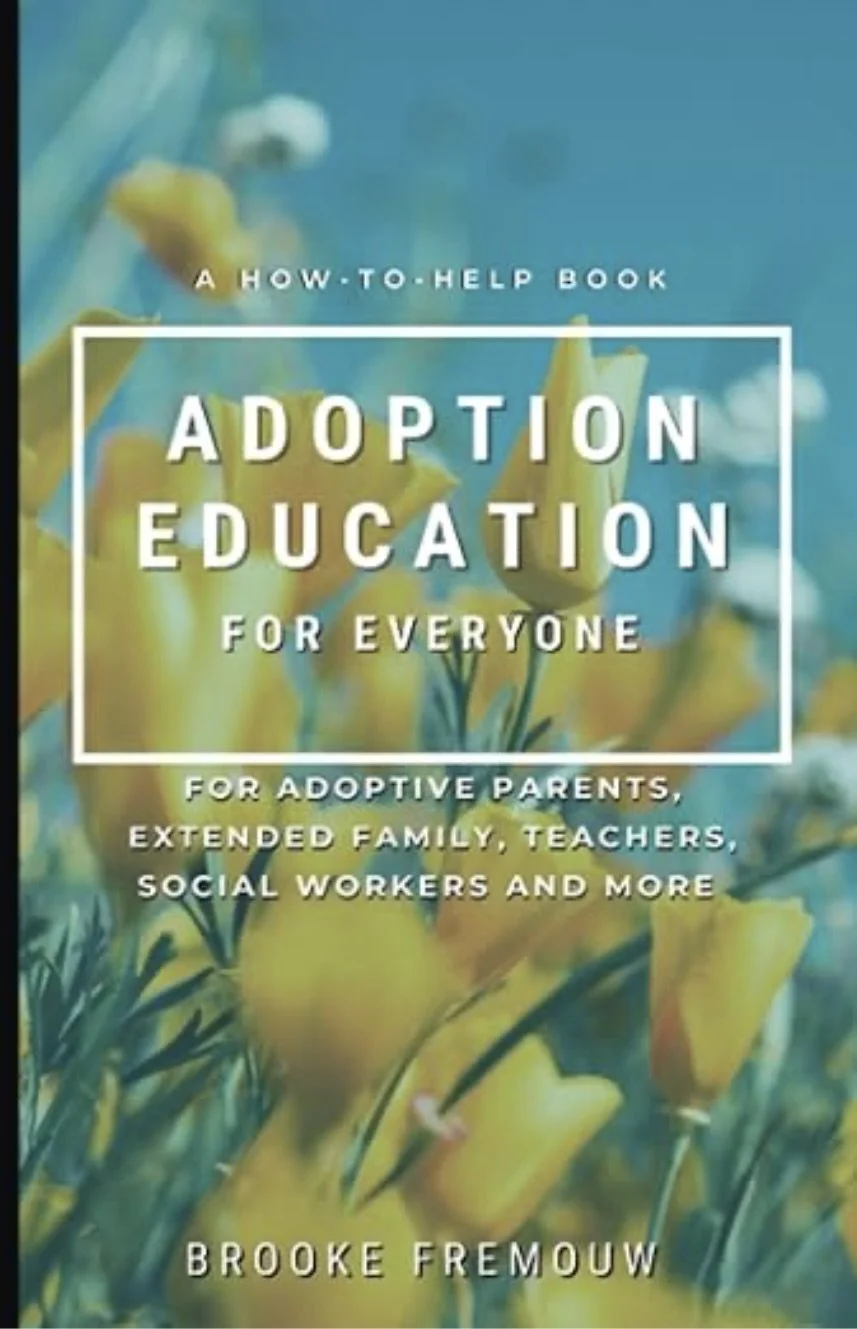
Adoption Education for Everyone: For Adoptive Parents, Extended Family, Teachers, Social Workers, and More
— Written and self-published by Brooke Fremouw (adoptive parent), in 2023, 92 pg
— Review written by Heather Gonzales, Book read in 2023, Review updated 2025
Full Review & Considerations:
While the title seems to indicate “education” on adoption, the book is mostly opinions or things gleaned by the author, as an adoptive parent. There is almost no research or other educational materials cited or listed in the back. Material is lightly covered and skimmed through, and each chapter/topic is a couple of pages long.
The author says that she wants to advocate for adoption as a movement, but regardless of her intent, this does not seem to extend much to the adoptee perspective or voice. For example, in chapter 7, the author advocates for the idea that adoptees should not be called “lucky”. However, her argument is based on her own feelings of its use, not an adoptee’s, and the oversharing of her adopted son’s trauma (which she says he permitted her to share) is unnecessary to make her point.
The book reflects themes of ownership and Savorism in both overt and subtle ways, and several chapters seem mostly about self-advocacy or defending her personal choices/beliefs related to adoption.
In chapter 3, the author could have advocated for several adoptee related legacy issues, including the idea of “chosen family” or open adoptions. Instead, the author advocates for “bonus children” (p. 22) and an adoptive parent’s right to broaden the definition of who they should be allowed to claim as one of their children. The author argues that the birth sibling of an adopted child, who lives in a different country, and who is “dependent to the [sibling’s adoptive] parents,” should be considered their own child. The author leaves out any mention of whether money is given, or if the sibling is living with family in their birth country.
The author includes a fair amount of religious references that could be painful for adoptees, and/or leaves out the historical context and definition of Biblical adoption, For example, the author writes, “Through a series of ups and downs and a lot of struggle of ‘my will’ vs ‘the Lord’s will’, our hearts were eventually opened up to the idea that our family would grow through adoption” (p. 5); or “It’s a cool thing to walk in adoption as all of us are adopted into God’s family.”
In chapter 4, the author acknowledges that praising adoptive parents and discussing the sacrifices and struggles they make ”in front of adopted children can reinforce internal messages rooted in shame” (p. 31) and “exacerbates” their issues (p 32). And even though the author sees this in her own adopted children, she states that she continues to allow it because the benefit of “furthering the good work” outweighs the hardship it causes her adopted children. But then in chapter 11, the author asks that stories with only negatives, stories unlike hers, in which “God is using our pains, struggles, joys, and victories to further the good work”(p. 32), not be shared with prospective adoptive parents.
© 2025, Heather Gonzales, Encompass Adoptees - All Rights Reserved
Please Note:
List and comments reflect the individual opinions of Heather Gonzales and are written from the perspective of an adoptee, for those looking for resources for adoptees or adoptive families specifically. Lists are not necessarily a reflection of all staff or Encompass Adoptees as a whole. At Encompass, we recommend that, whatever you read, no matter who recommends it or writes it, readers use critical thinking and that the content is reviewed in a thoughtful, contemplative, and reflective manner.
Additional lists, books, details, and reviews are added periodically.